



Upon invitation of the Commission for foreign affairs of the Belgian Chamber of Representatives, colleagues of the University of Ghent and Utrecht University drafted a...
Learn more

News
17-06-26
International Law in Belgian Courts (ILBC) database updates have resumed!
We’re pleased to share that updates to the International Law in Belgian Courts (ILBC) database have resumed!
The ILBC database aims to collect and organize judgments of Belgian courts and tribunals that engage with public international law, including topics such as immunities, jurisdiction, international criminal law, and more. Each case includes a full-text version of the judgement (in the original language) and a concise English summary highlighting its relevance to public international law.
Call for submissions!
Have you come across Belgian case-law touching on matters of public international law in your studies or practice? We warmly invite students, researchers, and practitioners to contribute to the database. More information can be found on the ILBC website and questions/submissions can be sent to grili@ugent.be.
Some of the latest additions include (contributions by Frederik Rogiers, Quinten DeGroote, Maxime Nijs, and Ioannis Bamnios):
- The judgment of the Leuven Assize Court of 14 December 2023, convicting former Guatemalan officials for crimes against humanity and applying the concept of joint criminal enterprise as a mode of liability;
- The judgment of the Belgian Supreme Court of 8 April 2024, addressing State immunity in employment disputes and the distinction between acta jure imperii and gestionis;
- The judgment of the Brussels Court of Appeal of 2 December 2024, recognising the forcible removal of mixed-race children during colonial times as crimes against humanity and confirming their non-prescriptibility;
- The decision of the Board for Maritime Investigation of 3 June 2025, examining the definition of a warship under UNCLOS and the applicability of the Maritime Labour Convention;
- The judgment of the Belgian Supreme Court of 29 July 2025, clarifying the “reasonable period” during which diplomats continue to benefit from immunity after their posting has ended.
News
07-10-26
5th Edition of the International Order and Justice Lecture Series
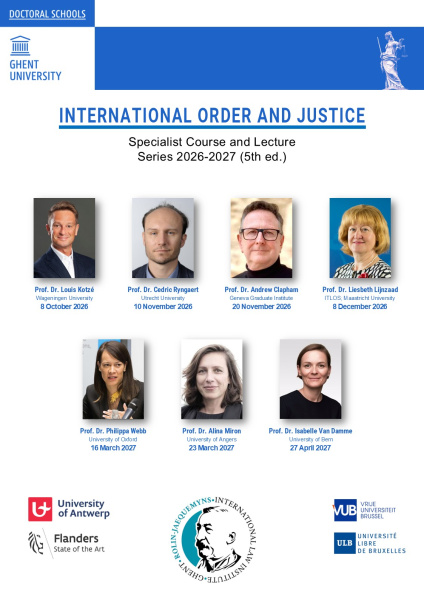
Following the success of previous editions, GRILI is pleased to announce the fifth edition of the International Order and Justice Lecture Series, taking place in the 2026–27 academic year at Ghent University's Faculty of Law and Criminolgy.
The series will bring together seven undisputed ‘heavyweights’ in the broader international legal domain for a series of public lectures and closed, interactive sessions with doctoral and post-doctoral researchers. The public lectures will address a wide array of contemporary issues, ranging from the international legal regime governing deep seabed mining, the prospects of criminalizing ‘ecocide’, the question of the strengths and shortcomings of the laws of war, or the EU’s commitment to international trade law. Particular attention is devoted to the interaction between law and politics, and the evolution of international law’s place in the international community. During the closed interactive sessions, one or more (Post-)doctoral researchers will have the opportunity present their research, and receive first-hand feedback from an established legal scholar in their domain. Other doctoral researchers will be able to engage in the ensuing debate.
The lecture series is organized under the auspices of the Ghent Rolin-Jaequemyns In-ternational Law Institute (GRILI), in partnership with the Vrije Universiteit Brussel, the Université Libre de Bruxelles, and the University of Antwerp. It is made possible through the financial support of the Doctoral School of Arts, Humanities and Law at Ghent University.
Practical information:
Participation in the Specialist Course is open to all doctoral and post-doctoral researchers, whether from Ghent University or external institutions. Other persons wishing to participate in the interactive sessions should inquire with the organizers. Reading materials will be distributed to enrolled candidates, prior to the lectures. Those who enroll and participate in all lectures can obtain an ECTS certificate from the Ghent University Doctoral Schools administration. (Post-)doctoral researchers wishing to present during one of the interactive sessions are invited to submit a short proposal (abstract of no more than 300 words) to the organizers (tom.ruys@ugent.be) and specify the session during which they would like to do so. Presentations need not coincide with the topic of the concomitant public lectures, but should be related to the broader expertise of the external speakers.
About the institute
The Ghent Rolin-Jaequemyns International Law Institute is a vibrant research institute, composed of ten faculty members and more than 20 doctoral and post-doctoral researchers. Its activities span the entire realm of public international law, ranging
from the law of armed
conflict and interna-
tional human rights
law, to the law of the
sea, international en-
vironmental law and
international criminal law.