5th Edition of the International Order and Justice Lecture Series
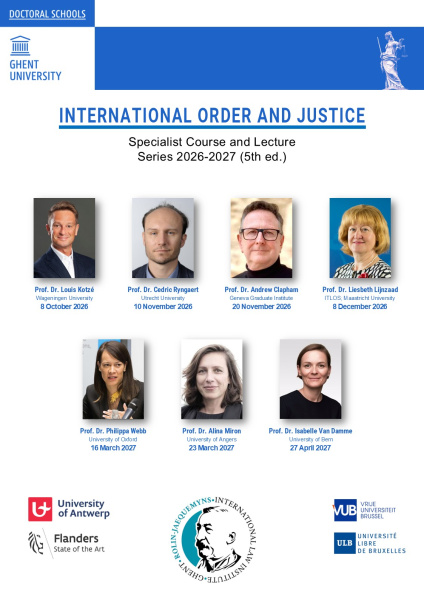
Following the success of previous editions, GRILI is pleased to announce the fifth edition of the International Order and Justice Lecture Series, taking place in the 2026–27 academic year at Ghent University's Faculty of Law and Criminolgy.
The series will bring together seven undisputed ‘heavyweights’ in the broader international legal domain for a series of public lectures and closed, interactive sessions with doctoral and post-doctoral researchers. The public lectures will address a wide array of contemporary issues, ranging from the international legal regime governing deep seabed mining, the prospects of criminalizing ‘ecocide’, the question of the strengths and shortcomings of the laws of war, or the EU’s commitment to international trade law. Particular attention is devoted to the interaction between law and politics, and the evolution of international law’s place in the international community. During the closed interactive sessions, one or more (Post-)doctoral researchers will have the opportunity present their research, and receive first-hand feedback from an established legal scholar in their domain. Other doctoral researchers will be able to engage in the ensuing debate.
The lecture series is organized under the auspices of the Ghent Rolin-Jaequemyns In-ternational Law Institute (GRILI), in partnership with the Vrije Universiteit Brussel, the Université Libre de Bruxelles, and the University of Antwerp. It is made possible through the financial support of the Doctoral School of Arts, Humanities and Law at Ghent University.
Practical information:
Participation in the Specialist Course is open to all doctoral and post-doctoral researchers, whether from Ghent University or external institutions. Other persons wishing to participate in the interactive sessions should inquire with the organizers. Reading materials will be distributed to enrolled candidates, prior to the lectures. Those who enroll and participate in all lectures can obtain an ECTS certificate from the Ghent University Doctoral Schools administration. (Post-)doctoral researchers wishing to present during one of the interactive sessions are invited to submit a short proposal (abstract of no more than 300 words) to the organizers (tom.ruys@ugent.be) and specify the session during which they would like to do so. Presentations need not coincide with the topic of the concomitant public lectures, but should be related to the broader expertise of the external speakers.
International Law in Belgian Courts (ILBC) database updates have resumed!
We’re pleased to share that updates to the International Law in Belgian Courts (ILBC) database have resumed!
The ILBC database aims to collect and organize judgments of Belgian courts and tribunals that engage with public international law, including topics such as immunities, jurisdiction, international criminal law, and more. Each case includes a full-text version of the judgement (in the original language) and a concise English summary highlighting its relevance to public international law.
Call for submissions!
Have you come across Belgian case-law touching on matters of public international law in your studies or practice? We warmly invite students, researchers, and practitioners to contribute to the database. More information can be found on the ILBC website and questions/submissions can be sent to grili@ugent.be.
Some of the latest additions include (contributions by Frederik Rogiers, Quinten DeGroote, Maxime Nijs, and Ioannis Bamnios):
-
The judgment of the Leuven Assize Court of 14 December 2023, convicting former Guatemalan officials for crimes against humanity and applying the concept of joint criminal enterprise as a mode of liability;
-
The judgment of the Belgian Supreme Court of 8 April 2024, addressing State immunity in employment disputes and the distinction between acta jure imperii and gestionis;
-
The judgment of the Brussels Court of Appeal of 2 December 2024, recognising the forcible removal of mixed-race children during colonial times as crimes against humanity and confirming their non-prescriptibility;
-
The decision of the Board for Maritime Investigation of 3 June 2025, examining the definition of a warship under UNCLOS and the applicability of the Maritime Labour Convention;
-
The judgment of the Belgian Supreme Court of 29 July 2025, clarifying the “reasonable period” during which diplomats continue to benefit from immunity after their posting has ended.
New blogpost: Jamming Enemy Weapon Systems and the Law of Targeting
GRILI researcher, Maxime Nijs, has published a new article on Articles of War, examining how the rules of international humanitarian law (IHL) governing the conduct of hostilities (also referred to as the law of targeting) apply to electromagnetic warfare (EW) countermeasures against enemy weapon systems, such as jamming and spoofing.
The article explores the significant interpretative challenges these operations raise, particularly regarding the notion of an “attack” under IHL. It argues that defensive EW operations that foreseeably cause physical harm may qualify as attacks, thereby triggering attack-specific targeting obligations. The analysis further highlights that belligerents cannot disregard an adversary’s EW capabilities when planning and conducting operations. Rather, such capabilities must be taken into account when assessing proportionality and the implementation of precautions
As EW capabilities continue to proliferate, the article underscores the need for both attackers and defenders to carefully calibrate their operations in light of their legal obligations, especially where EW techniques create uncertainty regarding the location and manner of potential civilian harm.
Read the full article 'here'
Expert Seminar by Prof Alexandra Hofer: "Article 2(4) is Dead; Long Live Article 2(4)!"
 There is currently no shortage of commentaries on the relevance of international law, and the prohibition to use force in particular, as the world undergoes geopolitical upheaval. For Western policy-makers, the challenge to international law – or the so called ‘rules-based order’ – is often laid squarely on Russia, China and Iran. However, over the past year Canada, the UK, and other European states, with a few exceptions, have done little to challenge the US’s unjustified uses of force in Venezuela and Iran, and have stood idly by as Israelillegally intervenes throughout the Middle East. In some cases, they have suggested that these interventions are legitimate and have questioned the relevance, or utility, of international law.
On 29 May, GRILI is pleased to welcome back Prof. Alexandra Hofer (Utrecht University) to our faculty for a thought-provoking seminar on the law on the use of force, entitled: “Article 2(4) is Dead; Long Live Article 2(4)!”
During this seminar, Prof. Hofer will argue that because of the importance of regulating the use of force in inter-state relations, Article 2(4) may be revisited and revised, but it will not die. The same, however, cannot be said about the reputation and credibility of those who breach it and who do not defend it. The stakes are especially high for actors such as the US and the European Union who portray themselves as ‘enforcers’ of the ‘rules-based order’.
Practical details:
-
Date and time: Friday 29 May, 13:30-14:30
-
Location: ICRP ‘Liberty’ meeting room (Emile Braunschool, 3rd floor)
-
Registration: This event is open to all interested participants. Please register by emailing grili@ugent.be no later than 28 May.
Frederik Rogiers teaches law of naval warfare at the Belgian Red Cross
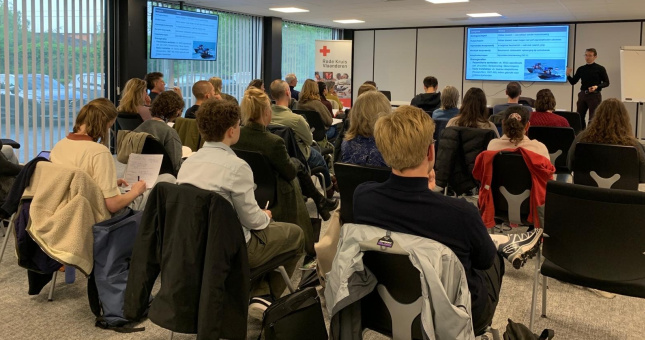
On 19 May 2026, Frederik Rogiers (PhD researcher and teaching assistant) delivered a guest lecture on the law of naval warfare as part of the 28th edition of the International Humanitarian Law (IHL) lecture series, organised by the Belgian Red Cross in Mechelen. The session brought together a diverse audience of students, legal practitioners, government officials, and participants without a legal background. In this setting, the lecture explored the growing relevance of international humanitarian law in the maritime domain, particularly in light of today’s evolving geopolitical context. Key topics addressed during the lecture included: the application of international humanitarian law at sea and its relationship with the law of the sea, means and methods of naval warfare including the use of exclusion zones, blockade, mines and submarines, as well as the importance of soft law instruments such as the San Remo and Newport Manual.
Quinten DeGroote invited as facilitator at the Law of Naval Warfare Academy in Lisbon
Last week, GRILI researcher Quinten DeGroote was called upon by prof. James Kraska to appear as a facilitator at the Law of Naval Warfare Academy in Lisbon, Portugal! The Academy brought together government officials, military legal advisers and academics to deepen their understanding of the law of naval warfare, an area that has firmly returned to the forefront of international attention. During the mornings, participants learned from leading experts in the field, including Prof. Wolff von Heinegg, Prof. David Letts and Prof. James Kraska. In the afternoons, academics like Quinten were given the responsibility of facilitating small-group, scenario-based exercises and guiding participants as they applied legal principles to real-world situations.
This edition of the Academy was hosted by the NATO Maritime GEOMETOC Centre of Excellence and organised by the NATO Centre of Excellence for Operations in Confined and Shallow Waters (COE CSW), together with the Stockton Center for International Law of the U.S. Naval War College.
New blogpost out: The Use of Convoys and the Risk of Having Convoys with Combined US & Neutral Escorts
New publication out by GRILI-member, Yiannis Bamnios in Opinio Juris:
The article examines the legal risks of using mixed convoys—specifically those combining U.S. (a belligerent) and neutral naval escorts—to reopen the Strait of Hormuz after Iran’s closure. Under the Law of Naval Warfare, only convoys composed entirely of neutral merchant ships escorted solely by neutral warships are exempt from visit, search, or attack. Any involvement of U.S. or other belligerent warships renders the entire convoy a lawful military target. The piece warns that proposed multinational escort arrangements could unintentionally forfeit neutrality protections and expose participating vessels to legitimate force.
Read the full article 'here'
Expert Seminar: Russia, the Soviet Union and Imperial Continuity in International Law
To what extent do imperial and Soviet legal traditions continue to shape today’s international legal order? And how do these historical frameworks influence contemporary understandings of statehood and sovereignty?
These questions lie at the heart of Professor Lauri Mälksoo’s (University of Tartu) latest monograph, Russia, the Soviet Union, and Imperial Continuity in International Law (Oxford University Press 2025).
On 27 April 2026, GRILI and the Ghent Legal History Institute are pleased to welcome Professor Mälksoo to our Faculty for an expert seminar on his new book. The event takes place within the framework of the FWO Senior Research Project ‘Soviet Approaches to Emergency’ and will be moderated by Dr Alina Cherviatsova.
Practical details:
• Timing: 18:30 – 20:00
• Location: Campus Aula, Universiteitstraat (Room 8.1)
• Registration is required through ‘this link’.
Frederik Rogiers teaches maritime security at HZ University Vlissingen
On 21 April 2026, Frederik Rogiers (PhD researcher and teaching assistant) delivered a guest lecture at HZ University of Applied Sciences in Vlissingen, addressed to students enrolled in the four-year Bachelor programme to become a Maritime Officer (HBO Maritiem Officier). His lecture focused on the growing importance of maritime security in today’s geopolitical and economic environment. As future maritime officers, the students were introduced to the complex realities they may encounter in their professional careers at sea, including the increasing number of maritime security threats from piracy and smuggling to hybrid and state-led activities; the legal framework governing maritime operations both in peace and in times of conflict, current challenges such as the protection of critical maritime infrastructure and the rise of "shadow fleets", as well as the resurgence of naval warfare. The lecture aimed to show that modern maritime professionals must operate at the intersection of technical, economic, and legal considerations - reflecting the increasingly complex environment in which global shipping takes place.
GRILI-GELI Seminar: Navigating International and EU Law in the Debate on Russian Central Bank Assets
On 2 April, GRILI and the Ghent European Law Institute (GELI) are pleased to invite you to a lunch seminar examining the international and European legal questions surrounding the frozen assets of the Russian Central Bank.
The seminar will feature presentations by Philippe Kehl, PhD Candidate and Research Assistant at Bucerius Law School (Hamburg), who will address key issues arising under international law, including questions of State immunity and the law of State responsibility, and by Professor Peter Van Elsuwege, who will explore the matter from the perspective of European Union law, focusing in particular on the legal bases of EU sanctions and the reparations loans granted to Ukraine.
Practical details:
-
Date and time: 2 April 2026, 12:00–13:30
-
Venue: Room Fairness, Faculty of Law and Criminology
-
Registration: This seminar is open to all interested participants upon registration. Please confirm your attendance by contacting kristien.ballegeer@ugent.be